A portfolio of favorites from my collection
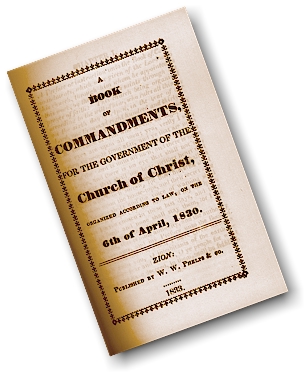
where this rarest Mormon book was printed in 1833
The church library, archives, and museum is open to any researcher by appointment. I am also working endlessly to get the most important parts of my collection online in PDF format. I have a site entitled iNephi.com which has the first edition Book of Mormon viewable online. I have photographically reprinted more than one hundred faithful books published during the lifetime of Joseph Smith.
I have purchased at least 100,000 books and other Mormon items. I am qualified and interested in purchasing anything that you offer to me. I have listed a selection from the more important books and museum-quality artifacts that I have bought or sold over the years―these are examples of high-end items (those valued at $5,000 and up).
ABOUT THE SELLER
Hajicek Family Legacy
—John Hajicek (pronounced high-Czech) was born with Bohemian ancestry in Minnesota, where the Hajicek family has been professionally preserving valuable artifacts since 1918. John has been a student of Mormon history since 1973. In 1980, his father moved their family to the county-line road named “Mormon Road” at a ghost-town named Voree, Wisconsin. Voree is a Nauvoo-era Mormon historic site, where Joseph Smith Sr. originally established a settlement in the 1830s. Joseph Smith Jr. appointed Voree to be a stake in 1844, and it flourished as a village until the 1850s. The Mormons at Voree were the primitive Mormons who did not go west, but remained in the Great Lakes states, rallying around alternative leaders with Nauvoo general authorities, the Book of Mormon witnesses, and the Smith family.
Hajicek Integrity
—John Hajicek was ordained in 1982 into an independent lineage of elders in the nearly-vanished Voree church, with only two ordinations between his ordination and a man ordained by Joseph Smith Jr. in 1831. John was ordained by a man whose grandfather lived in Palmyra, New York; and Nauvoo, Illinois. The rare provenance of John’s ordination parallels the remarkable provenances of his discovered Mormon treasures. The remnant of old descendants in the Midwest then designated John to be their archivist. Staying faithful to that exceptional history shows continual integrity. Although John was always more of a historian than a preacher, he retains that distinctive Mormon genuineness and Mormon values.
Insistence on Authenticity
—In 1981, John Hajicek began writing for publication, to question the reliability of Mormon documents which were then making national news—which later proved to be forgeries as John had already determined. John took the lead then, and has continued to lead in his field, challenging LDS historians, LDS booksellers, and LDS collectors to fully document sources, use authentic originals, do minimalist restoration, and have reliable provenances. In 1982, John bought his first Joseph Smith-period Book of Mormon. John now has over four decades of experience examining rare Mormon books, documents, and art.
Advanced Education
—In the 1980s and 1990s, John Hajicek was an undergraduate and graduate student of economics at universities in Wisconsin, Florida, and Missouri. He later sent his two daughters to Brigham Young University, where one of them earned a degree in history at age twenty.
Historic Site Preservation
—John Hajicek’s love for preservation shows in his interest in historic sites. In the late 1980s, John moved from the Mormon historic site at Voree, Wisconsin, to the Mormon historic site of Independence, Missouri. In 1991, he restored an 1840s Mormon stone house back in Wisconsin. He has now lived in the same museum-style house in Independence for more than a quarter century. He has visited the Mormon historic site at Nauvoo, Illinois, a hundred different times, and saved Nauvoo’s architectural artifacts. He has preserved hundreds of early maps of Mormon historic sites, and thousands of first-century photographs of Mormon architecture, including from New England, New York, and the Midwest.
Sharing of History
—John Hajicek shares his historic discoveries with his colleagues and other museums who reciprocate. In the early 1980s and early 1990s, John published many of his discoveries for the use of scholarly and research libraries. In 1996, he began adding rare books to the Internet at sites like Mormonism.com and iNephi.com. He is presently writing several volumes entitled Discoveries in Mormonism which will include his most important discoveries. John works to make the newest authentic discoveries in early Mormon history, and share the finest rare Mormon treasures with university special-collections libraries and with sophisticated fellow-collectors in the Great Basin and California. He regularly travels to the West to meet with knowledgeable collectors who are leaders in business, government, academics, museums, and the LDS Church. His home, with his library–archive–museum, is open by appointment. He has often assisted the LDS Church with history projects.
Priceless Treasures Discovered
—Famously, half of all new finds in Mormonism come through John Hajicek’s hands. He has discovered and possessed four copies of the rarest Mormon book of all, the 1833 Book of Commandments, printed in Independence, Missouri, where he now lives, including the Whitmer family copy. By 1991, John was the leading private collector of rare Mormon books. As of 2026, he has more Mormon manuscripts than all university archives outside of Utah combined; and he has more Mormon-related books than Brigham Young University and the LDS Church combined. John views collecting rare books as not spending money—but as investing money (Mormon books climbed in value a thousand-fold in the past fifty years). Investing in rare books is part of a plan of conservative stewardship. John has acquired and originally brought-to-light the following now-famous items:
- First edition Books of Mormon belonging to Joseph Smith Jr., Hyrum Smith, Brigham Young, Newel K. Whitney, and others.
- Joseph Smith-period Book of Mormon editions belonging to Emma Hale, Lucy Mack, Oliver Cowdery, Hiram Page, William McLellin, Willard Richards, George Miller, and others.
- First edition Doctrine and Covenants books belonging to Joseph Smith, Sidney Rigdon, the Cowdery family, David Whitmer, Brigham Young, and others.
- Seven copies of the second rarest Mormon book, the first edition Sacred Hymns, including a Cowdery family copy.
- Personal papers of Joseph Smith, his scribes, and his neighbors.
- The first Mormon newspaper and unique volumes of many other newspapers previously thought to be lost forever.
- Countless unique tracts from the period whose prior existence was otherwise unknown.
- Artifacts such as a Nauvoo temple sunstone and moonstone.
- Many paintings and drawings of Joseph Smith and his family made from life.
- Joseph Smith’s personal possessions, such as his hunting rifle, and his own hand-drawn map from his settlement of Far West, Missouri.
- A colored artwork of the Independence, Missouri, 1831 temple made by a teenage girl in the home of Joseph Smith.
Hajicek as a Professional Historian
—John Hajicek has now been a Mormon history student since 1973, a Mormon historian since 1980, and a full-time professional Mormon historian since 1990. He is the only historian with his range of experience in Mormon books, early Mormon documents, and other cultural artifacts.
Hajicek’s Specializations
—As a historian, John Hajicek has particular strengths. He specializes in Joseph Smith roots, Mormon origins, Mormon economics, Mormon presidential succession, Mormon printing, Mormon architecture, early Mormon art, Mormon maps, Mormon newspapers, Mormon vernacular photography, and important Mormon documents. He is currently writing a biography entitled Joseph Smith Sr. in New-England and New-York, 1791-1836, using unique sources in his private collection.
Scriptures
Book of Mormon
- The 1830 (Palmyra, N.Y.) Book of Mormon, approximately 100 copies, many with the References supplement, one signed by Joseph Smith Jr., one belonging to the Joseph Smith Jr. family, one signed by Brigham Young which converted him, one signed personal copy of Hyrum Smith handed down in a slave family, two belonging to bishop Newel K. Whitney, one in treed calf, and one bound in Kirtland, Ohio. Every copy of this book is unique and I am seeking additional copies.
- The 1837 (Kirtland, Ohio) Book of Mormon, approximately 25 copies, including one belonging to the witness Hiram Page, one bound in ornate red morocco as a presentation by Oliver Cowdery to his family, one copy belonging to Joseph Smith, some copies in treed calf, and many other copies including some in a deluxe binding with tiny gold Kirtland trumpet devices stamped on the boards.
- The 1840 (Nauvoo, Ill.) Book of Mormon, approximately 50 copies, including one owned by Luck Mack Smith, one signed by Nauvoo bishop George Miller, and copies representing more than three different printings from Cincinnati and Nauvoo.
- The 1841 (Liverpool, England) Book of Mormon, approximately 50 copies, including one belonging to Lucy Mack Smith in a presentation binding, and other presentation copies.
- The 1842 (Nauvoo, Ill.) Book of Mormon, approximately 20 copies, including a copy from Emma Hale Smith.
- A fine selection of Books of Mormon from 1849, and the 1850s, 1860s, and 1870s, including a fine copy signed by Brigham Young, a copy signed by John Taylor, a copy of the first Utah edition, and a copy of the first Smith family edition from Plano, Ill. with a red-line border on the title page.
Doctrine and Covenants
- A Book of Commandments (Zion: 1833), four copies.
- The 1835 Doctrine and Covenants (Kirtland, Ohio), approximately 25 copies, including four in presentation bindings, one signed and annotated by Sidney Rigdon, another by David Whitmer, one belonging to Joseph Smith, and the fourth in an Oliver Cowdery family presentation binding in full red morocco; and many other copies in plain brown sheep or treed calf including a second Smith copy handed down in the family.
- The 1844 Doctrine and Covenants (Nauvoo, Ill.), approximately 10 copies.
- The 1845 Doctrine and Covenants (Nauvoo, Ill.), approximately 10 copies.
- The 1846 Doctrine and Covenants (Nauvoo, Ill.), approximately 10 copies.
- A fine selection of copies of the Doctrine and Covenants from 1845 through the 1850s, 1860s, and 1870, printed in Liverpool England, up through a copy of the first Utah edition.
Hymns
- The 1835 Mormon Sacred Hymns (Kirtland, Ohio), seven copies, including one in an Oliver Cowdery family presentation binding in full red morocco, in the finest condition known for this book.
- The 1841 Mormon Sacred Hymns (Nauvoo, Ill.), three copies.
- A selection of other significant but obscure Mormon hymn books from the 1830s, 1840s, 1850s, including one by David W. Rogers (New York: 1838), one by Benjamin Elsworth (New York: 1839), the first British one (Manchester: 1840), and the first with musical notes by Little-Gardner (Bellows Falls, Vermont: 1844), and many others by obscure leaders including one by John Hardy, and one by Charles A. Adams; and two by the church led by James J. Strang (1849 and 1850); and from the 1860s one edition printed by William Bickerton, one offshoot edition printed in Kirtland, Ohio, and two more editions printed by Emma Smith after the death of her husband.
Other
- James J. Strang’s Book of the Law of the Lord, the first edition of 80 pages (only 200 copies printed), published in 1851; a copy of the 1856 edition of 336 pages in uncut sheets, and a finely bound copy belonging to his family; and a broadside representation of his Voree Plates.
- The Pearl of Great Price, many copies of the first edition (1851), including a half-dozen in original salmon colored wrappers.
- Many copies of the first edition Holy Scriptures―The Joseph Smith Translation (JST)―imprinted by Joseph Smith’s family (Plano, Ill.: 1867), including several in presentation bindings, one in a deluxe red morocco binding, one in wrappers; one deluxe copy belonging to Joseph Smith III, and several New Testaments (Plano, Ill.: 1867) bound separately, including one with marbled endpapers and marbled edges.
- The Holy Bible from Cooperstown, New York, 1828, the same edition used by Joseph Smith while translating the Book of Mormon and the Bible.
Newspapers
- Early church newspapers including the Independence and Kirtland edition of the Evening and Morning Star; all three volumes of the Kirtland Messenger and Advocate; the exceptionally rare Elders’ Journal from the vanished town of Far West, Missouri, belonging to Samuel H. Smith; issues of the Times and Seasons signed by Brigham Young and Newel K. Whitney, several complete sets of all six volumes, and rare July 1839 state of the first number; the editor’s copy of the Millennial Star from England and volume one in unique printed wrappers; issues of the New York Prophet and New York Mormon; and the New-York Messenger (the only complete bound volume, including an Extra and a previously unknown 22nd number), and the known only set of the Gospel Reflector in original printed wrappers.
- Newspapers from all the divergent leaders, including George M. Hinckle’s Ensign, Sidney Rigdon’s Messenger and Advocate, James C. Brewster’s Olive Branch, James J. Strang’s Northern Islander (the only extant bound run), the most complete extant set of Voree and Gospel Heralds, Charles B. Thompson’s Baneemy’s Organ, the rare first complete volume of Brigham Young’s Deseret News, the early volumes of Joseph Smith III’s Saints’ Herald in wrappers, and Granville Hedrick’s Truth Teller; and an 1844 issue of the New York Weekly Herald with engravings of the assassination of Joseph Smith.
Pamphlets
- Historic polemical pamphlets, including the first anti-Mormon pamphlet (Alexander Campbell’s Delusions, 1832); the first anti-polygamy pamphlet (the only known copy of Oliver Olney’s Spiritual Wifery); the first Temple expose (Increase Van Deusen’s Mormon Endowment, Albany, 1847, in wrappers).
- Rare broadsides from the 1840s, some unique in the Mormon bibliographies, and some of those unique ones printed in early frontier Nauvoo.
- Rare pamphlets such as the Voice of Truth, published by Joseph Smith at Nauvoo; his Reply to James A. Bennett; and an 1844 pamphlet about his martyrdom; Parley P. Pratt’s Millennium and Other Poems, and the first two editions of Pratt’s Voice of Warning (1837 and 1839).
- The only known copy of Joseph Smith’s first vision with a wrapper, the front wrap only (Orson Pratt’s Interesting Account of Several Remarkable Visions, 1840), which was incidentally signed by apostle John E. Page. Update: As of 2013 I have discovered a second copy of this with front and rear wrappers.
- All three of John E. Page’s Gospel Tracts, numbered 1-4, (1847).
- An uncut copy of James J. Strang’s Prophetic Controversy (Beaver Island, 1856); and a complete set of his other major Voree and Beaver Island pamphlets all in wrappers, such as his Diamond, Catholic Discussion, Michilimackinac, and Epistles of Oliver Cowdery.
- The first two pamphlets published by the Reorganization, 1853-1854 (Voice of the Captives and A Word of Consolation).
Manuscripts
Documents signed by Joseph Smith Jr., Oliver Cowdery, James Sloan (Hyrum Smith’s clerk), W. W. Phelps, Emma Smith, Brigham Young, and others.
- A letter from Brigham Young giving his sympathies to the family of a victim of the Mountain Meadows Massacre.
- The original indictment of Joseph Smith Jr. for theft in Missouri.
- The official Nauvoo court Mormon record book from 1837-1841.
- A trial of Joseph Smith and Sidney Rigdon in 1839, unpublished anywhere.
- The Nauvoo court record book of Joseph Smith III, 1850s and 1860s.
- The Chronicles of Voree, a rare manuscript record in the hand of James J. Strang.
- Manuscript depositions from the Order of Enoch trial held in Voree, Wisconsin.
- A collection of postmarks from Nauvoo, Illinois in the 1840s, plus a collection of postmarks from Palmyra, New York in 1830.
- Various manuscript collections of minor Mormon groups, including the collection of Warren Post with correspondence of other Mormons at Kirtland, Nauvoo, Voree, Beaver Island, and Council Bluffs; the papers of Wingfield Watson, and the diaries of Edward Chidester.
Art
The photo album of Julia Murdock Smith, the sister of the prophet, with carte-de-visite images of the wife and each of the children of Joseph Smith.
- A carte-de-visite collection of a neighbor of the children of Joseph Smith, who had rare images of all of the Smith family including unique portraits of the sisters of Joseph Smith.
- Another large carte-de-visite collection from the Joseph Smith family, including images of Joseph Smith, his brothers, and his sisters.
- The Sutcliffe Maudsley family collection with the majority of extant Maudsley images of Nauvoo residents, including William Smith, the brother of the prophet.
- A Sutcliffe Maudsley painting of Emma Smith and little Alexander Smith, painted in 1842, from the family of Alexander Smith, the son of Joseph (traded to the LDS Church).
- The Book of Mormon belonging to Sutcliffe Maudsley, containing his original first image of Joseph Smith from which all other profiles were made.
- A Sutcliffe Maudsley painting of Joseph Smith holding a red Bible.
- Another original Sutcliffe Maudsley portrait of Joseph and Hyrum Smith, this one in pencil.
- A collection of significant Sutcliffe Maudsley high detail steel engravings of Joseph Smith Jr., printed in 1842, 1847, and 1860; plus a collection of early Maudsley woodcuts from 1844 to 1845.
- Early b&w photographs of two Maudlsey paintings of Joseph and Hyrum Smith which are no longer extant.
- Bronze images of Joseph Smith by Maudsley, from wall art to lapel pins.
- Pieces of Staffordshireware made in England in 1847 with Sutcliffe Maudsley images of Joseph and Hyrum Smith and the Nauvoo temple.
- A full-color needlepoint sampler of the New Jerusalem Temple at Jackson County, Missouri, as it was planned in 1831, made by a Mormon girl living in Nauvoo in 1842.
- A hand-drawn map of Far West, Missouri, carried by Joseph Smith in his pocket.
- A painting by the Nauvoo artist David W. Rogers of his grandchildren playing at Winter Quarters.
- A pastel chalk drawing of Joseph Smith Jr. from the family of Katharine Salisbury, the sister of Joseph, after Sutcliffe Maudsley.
- Two 1848 pencil sketches of the Nauvoo temple by Seth Eastman.
- Early oil paintings of Nauvoo, Ill. by Lane K. Newberry.
- The original daguerreotype of King James J. Strang, and the original daguerreotype of his Castle.
- A tintype of the young sons of Joseph Smith Jr.
- A collection of cabinet cards and albumens of Lucy Mack Smith, Joseph Smith Jr., Hyrum Smith, William Smith, Catharine Smith, Emma Smith, Joseph Smith III, James J. Strang, and numerous other early church figures.
- The earliest known photographs of the Kirtland temple, taken fifteen years earlier than any other known photographs.
- A collection of albumens, and multiple unique custom stereoviews of Nauvoo homes that are no longer standing.
- A collection of photographs taken by the Joseph Smith family in the 1800s at Palmyra and Kirtland.
- A collection of lantern plates of the first Mormon temple in Kirtland, Ohio, and other scenes of historical sites and people including some taken in Nauvoo, Far West, and other places.
- A collection of b&w photographs printed on postcard paper of early church scenes, taken 1900-1915, particularly Kirtland, Ohio; and Nauvoo, Illinois.
- A collection of b&w photographs of the earliest Smith family homes and villages, in Royalton, and Sharon, in Vermont; in Palmyra, Manchester, Fayette, Bainbridge, and Colesville, in New York; and in Susquehanna, Pennsylvania.
- A collection of original prints of scenes from contemporary Kirtland and Nauvoo, including important images of the Temples; and, as an example, an otherwise unknown scene of Joseph Smith Jr. leaping from the Carthage Jail.
Artifacts
- Fragments from the Egyptian cloth used on the Joseph Smith mummies of the Book of Abraham.
- Joseph Smith Jr.’s red brick store sign, advertising tea and coffee with other dry goods, 1841.
- The chandelier from the Joseph Smith council room where the first Relief Society meetings and first secret endowments were held.
- A moon-stone from a pilaster base of the Nauvoo temple.
- A sun-stone piece (or trumpet-stone) from a pilaster capital of the Nauvoo temple, and numerous other pieces traded to me by the LDS Church but not yet received.
- Joseph Smith Jr.’s hunting rifle, and his watch fob (chain).
- A piece of the chain that held Joseph Smith Jr. in Liberty Jail, and the jail bars from the windows.
- A collection of Kirtland bank notes (some in uncut sheets), anti-bank notes, and Nauvoo House stock certificates, including money signed by Joseph Smith Jr., Sidney Rigdon, George Miller, and others.
- Mormon furniture such as letter boxes and tool chests, including a trunk belonging to Lyman Wight, and boxes from Beaver Island.